American Mahjong Tiles Explained
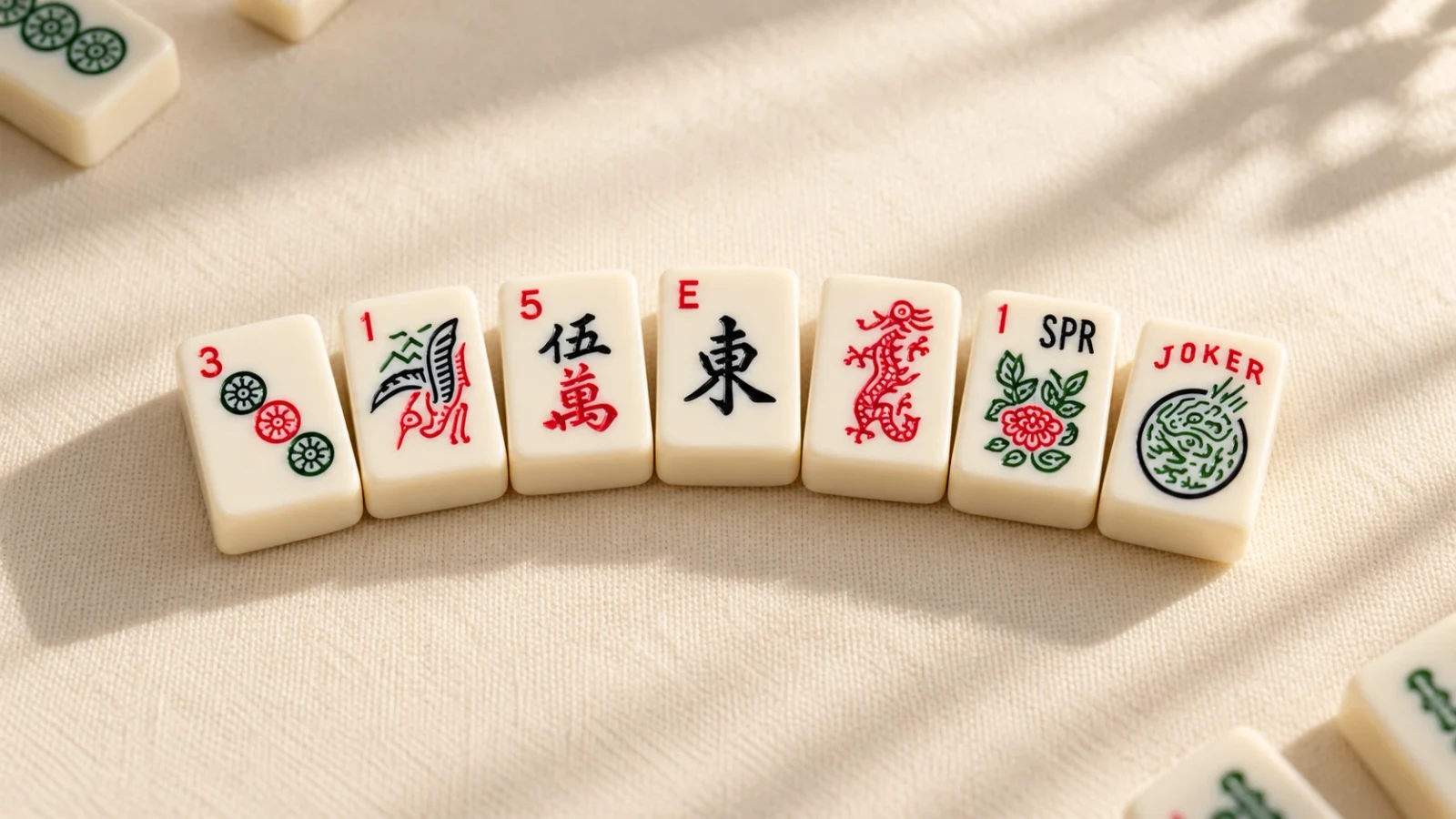
Open an American mahjong set for the first time and it can feel like a lot: 152 tiles, three kinds of numbers, pictures of flowers and dragons, and a few tiles that look almost the same. The set is easier to read than it first appears. Once you can tell the kinds of tiles apart, the card and the rules make more sense.
This guide goes through the tiles one kind at a time, with how many of each there are and how to spot them.
The set at a glance
An American set has 152 tiles:
- 108 suit tiles: Dots, Bams and Craks, 36 of each.
- 16 Winds: North, East, West and South, four of each.
- 12 Dragons: Red, Green and White, four of each.
- 8 Flowers.
- 8 Jokers.
Some sets come with extra Flowers, Jokers or blank tiles. If your set has more than 152 tiles, set the extras aside before you play.
The three suits
Each suit runs from 1 to 9, with four of every number. That makes 36 tiles per suit.
- Dots show round circles. Count the circles to read the number.
- Bams show bamboo sticks. Count the sticks to read the number. The 1 Bam is the exception: it usually shows a bird instead of a single stick.
- Craks show a Chinese character, the numeral for the number, with a second character below it that is the same on every Crak. American sets usually add the number in a corner, so you do not need to read the character.
If you have trouble telling the suits apart at a glance, look at the shape first. Circles are Dots, sticks are Bams, and characters are Craks.
The Winds
There are four Winds: North, East, West and South. Each one usually shows a Chinese character, with its letter (N, E, W or S) in the corner. Together they are called "NEWS."
There are four of each Wind, 16 in all. Winds do not belong to any suit.
The Dragons
The three Dragons are Red, Green and White. There are four of each, 12 in all.
- The Red Dragon usually shows a red dragon or a red Chinese character.
- The Green Dragon usually shows a green dragon or a green Chinese character.
- The White Dragon is usually a plain tile or a tile with a simple frame. It is also called Soap.
Each Dragon goes with one suit: Red with Craks, Green with Bams and Soap with Dots. The card tells you when a Dragon has to match a suit.
On the card, a White Dragon can also stand for zero. A Soap used as a zero is neutral, which means it can go with any suit. It is never part of a run of numbers.
The Flowers
An American set has 8 Flowers. They show pictures of flowers, and some sets add numbers or seasons to them.
In American mahjong, those numbers and pictures mean nothing, so every Flower is the same as every other Flower. When a hand on the card shows an F, any Flower fits there. A Flower is not a Joker, so it cannot stand in for another tile.
You can pass a Flower in the Charleston, as you would any tile except a Joker. The Charleston in American Mahjong, Step by Step shows how the passing works.
The Jokers
There are 8 Jokers, and most sets mark them with the word "Joker." A Joker can take the place of any tile in a group of three or more identical tiles. That means three of a kind (a pung), four (a kong), five (a quint) or six (a sextet). You can never use a Joker in a pair or as a single tile.
To see how Jokers work in a game, including how to trade for one, read How to Play American Mahjong: A Beginner's Guide.
A few tiles that get mixed up
Look twice at these:
- The 1 Bam and the Flowers. Both show pictures instead of simple shapes. A bird is the 1 Bam, and flowers are Flowers.
- The Green Dragon and the Bams. Both are often green. The Dragon shows a dragon or a character, and the Bams show sticks.
- Craks and Winds. Both show Chinese characters. Winds have a letter in the corner, so look for N, E, W or S.
- The White Dragon and blank tiles. If your set has framed White Dragons and blank tiles, the blanks are spares for replacing lost tiles. If it has blanks and no White Dragons, four of the blanks are your White Dragons.
Some designer sets change the pictures, and their Winds may be plain arrows. If you sit down with a set you do not know, look through its tiles before you play.
Why the count matters
There are four of each tile, apart from Flowers and Jokers. That means once you see all four 5 Dots, there are no more 5 Dots to wait for. Players use this to decide which tiles to keep. To learn how, read How to Keep Track of the Tiles in American Mahjong.
Where to go next
When you know the tiles, the next step is the card. Each year's card tells you which tiles make a winning hand.
If you would like the basics on the table while you learn, our Tile Shuffler cards come with a short guide to the game printed on both sides.
Have a question about these rules? Write to us. We read every message, and your question may become a future post.
Sources
We explain the rules in our own words, and everything in this post was checked against the official sources of the National Mah Jongg League:
- Mah Jongg Made Easy (2024 edition): page 5 (the number of tiles, the groups and the Winds), pages 5 and 6 (the Dragons and the Soap), page 6 (the suit each Dragon goes with and the Flowers), page 7 (the Jokers), pages 7 and 8 (the suits and the 1 Bam) and page 30 (the Soap as a zero).
- NMJL bulletin, 2014 questions and answers: question 3 (a Flower can be passed in the Charleston).
- NMJL bulletin, 2018 questions and answers: question 1 (a White Dragon used as a zero goes with any suit).
What the tiles look like changes from set to set, so the descriptions here are a general guide. The notes on blank tiles and designer sets are advice from Tom Sloper, not rules.
Mahjong help by email every week
Our newest blog posts and one rules question players often ask, with the answer. When we have a new book or accessory, you’ll read about it there too.
Keep reading
 Learn the game
How to Learn American Mahjong Before You Buy a Set
 Learn the game
How to Play American Mahjong: A Beginner's Guide