How to Play American Mahjong: A Beginner's Guide
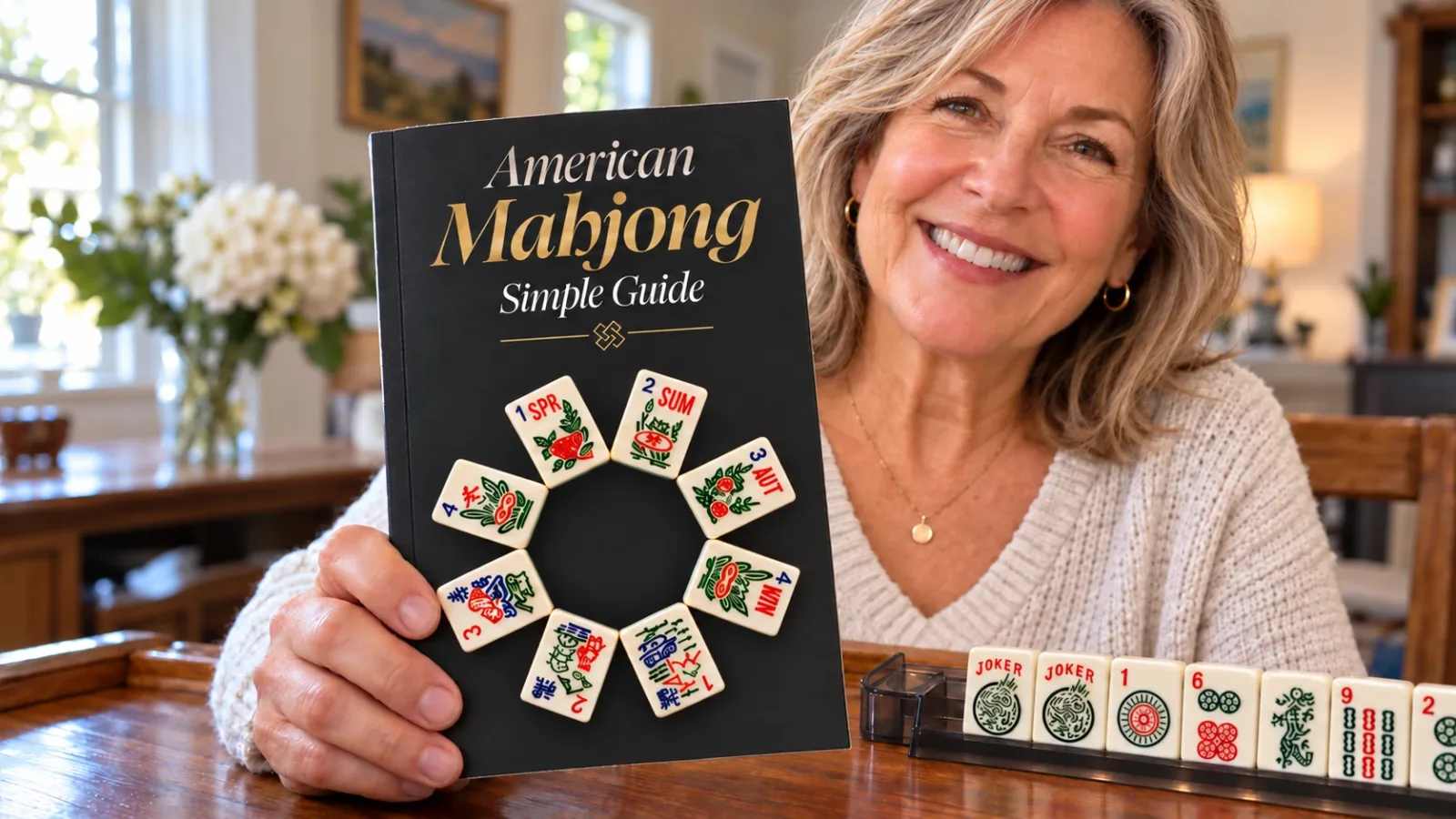
American mahjong can look complicated the first time you see it: 152 tiles, a card full of colored numbers, and four players passing tiles before anyone plays. The game has only a few moving parts, though. Once you know them, the rest comes with practice.
This guide walks you through one game, from the first tile to the winning hand. At the end, you will find the path experienced players recommend for learning, and how to recognize the official sources.
What you need
- A set of 152 tiles. An American set includes Jokers and Flowers.
- Four racks, one for each player. They hold your tiles and help you build the wall.
- A card with this year's hands. The hands change every year, so each player needs the current card. The National Mah Jongg League publishes one every year, and there are other cards too.
- Four players. Two or three can play with a few changes to the rules, but four is the usual game.
The tiles
- Three suits: Dots, Bams and Craks. Each suit runs from 1 to 9, with four of every tile. The 1 Bam is usually a bird.
- Winds: North, East, West and South, four of each.
- Dragons: Red, Green and White, four of each. Players call the White Dragon "Soap," and it can also stand for zero.
- 8 Flowers. The numbers and pictures on them do not matter.
- 8 Jokers. They can stand in for other tiles, with limits you will see below.
Each suit has its own Dragon: Red goes with Craks, Green with Bams and Soap with Dots.
For a closer look at each kind of tile, see American Mahjong Tiles Explained.
The goal
You win by being the first to complete a hand of 14 tiles that matches one of the hands on your card. The card sorts its hands into families, such as even numbers, and gives the value of each one.
On the League's card, two things confuse most new players.
- Colors do not stand for suits. A hand printed in one color can be played in any suit. Two colors mean any two suits, and three colors mean all three.
- X and C. Next to each hand, X means you may expose some of its groups as you go. C means the hand stays concealed on your rack until you win.
Setting up the game
- Build the wall. Turn all the tiles face down and mix them. Each player builds a wall 19 tiles long and 2 tiles high in front of their rack, and the four walls make a square.
- Choose East. At home, the host is usually East. East deals and starts the game with one extra tile.
- Break the wall and deal. East rolls the dice to find where to break the wall. Everyone takes tiles in groups of 4 until they have 12, and then one more. East ends up with 14 tiles and everyone else with 13.
The Charleston
Before anyone plays, players pass tiles to each other to improve their hands. This is the Charleston.
- The first Charleston is required. Pass 3 tiles to your right, then 3 across, then 3 to your left.
- A second Charleston is optional. It goes the other way, and any player can stop it.
- Last, you may trade up to 3 tiles with the player across from you.
- Jokers are never passed.
Each pass, and what to give away, is explained in The Charleston in American Mahjong, Step by Step.
Taking turns
East starts by discarding a tile face up and saying its name out loud, for example "Five Dot." Play then moves to the right. On your turn, take the next tile from the wall and then discard one. Say its name as you discard it.
After you discard, you always have 13 tiles, counting any you have exposed on top of your rack.
Calling a discard
You can use another player's discard without waiting for your turn. When someone discards a tile you need, say "Call!" or "I'll take that."
- To make a group. You may call a discard to complete three of the same tile (a pung), four (a kong) or five (a quint). Show the group on top of your rack, where everyone can see it, and then discard. Play continues to your right, and the players in between lose their turn.
- To win. You may call any discard that completes your hand, even a single tile or one tile of a pair. At any other time, you cannot call a tile for a single or a pair.
Call quickly. Once the next player has drawn from the wall and put the tile on their rack, the discard can no longer be called.
If two players call the same tile, a call to win beats a call for a group. If both want it for the same reason, the player next in turn gets it. But if the other player has already put the tile on top of their rack, or exposed tiles from their hand, the tile is theirs.
Jokers
- Jokers go only in groups of three or more of the same tile. You can never use one as a single tile or in a pair.
- You can trade for a Joker. If another player has a Joker in an exposed group, you can give the real tile it stands for and take the Joker. Do it on your turn, after you draw or call. Say that you want the Joker and hand your tile to its owner, who makes the trade and hands you the Joker. That way, nobody reaches into someone else's rack.
- A discarded Joker is dead. Nobody can call it.
Winning with Mah Jongg
When your 14 tiles match a hand on your card, say "Mah Jongg!" and lay your hand face up on top of your rack. Everyone checks it before anyone puts their tiles away. The last tile can come from the wall or from a discard.
If the wall runs out and nobody has won, it is a wall game. Mix the tiles again and start a new game.
After every game, the player to East's right becomes the new East.
Paying the winner
Each hand on the card has a value. Some groups play for coins, and others keep score on paper.
- Winning with a discard: the player who threw it pays twice the hand's value, and the others pay its value once.
- Winning with a tile from the wall: everyone pays double.
- Winning without any Jokers: the amounts double again. Singles and Pairs hands are the exception, because they never use Jokers.
Dead hands
A hand is dead when it can no longer win. This happens, for example, when a player has the wrong number of tiles or exposes a group that fits no hand on the card. That player stops drawing and discarding for the rest of the game. If someone else wins, that player still pays.
Another player has to point out a dead hand. Never declare your own hand dead. Keep playing until someone else does.
The path players recommend for learning
When a new player asks where to start, experienced players in mahjong groups give much the same advice:
- Watch beginner videos to see a whole game played from start to finish.
- Take a class if there is one near you.
- Join a beginner table, where everyone is learning and nobody minds a slow turn.
- Play on an app between games to practice.
- Practice by yourself. The League's rulebook suggests drawing 13 tiles at random, then drawing and discarding until you complete a hand.
For a quick review of the basics, see Learn to play. When you are ready to start watching the discards, read How to Keep Track of the Tiles in American Mahjong.
If you would like the basics on the table while you learn, our Tile Shuffler cards come with a short guide to the game printed on both sides.
How to recognize the official sources
The National Mah Jongg League was founded in 1937 to make the rules and hands of American mahjong the same everywhere. Each year it publishes its card. It also publishes the official rulebook, Mah Jongg Made Easy.
- If you play with the League's card, buy it from the League. Players often warn about unofficial copies. You can order it on the League's website, nationalmahjonggleague.org (opens in a new tab).
- Know the rulebook's name. Mah Jongg Made Easy is the League's rulebook. Other people write rule books too, and some of them contain mistakes.
- Check rules answers against the rulebook. Many players warn against asking an AI chatbot about the rules, because it can mix up American mahjong with other versions of the game.
Have a question about these rules? Write to us. We read every message, and your question may become a future post.
Sources
We explain the rules in our own words, and everything in this post was checked against the official sources of the National Mah Jongg League:
- Mah Jongg Made Easy (2024 edition): page 4 (the League's history), pages 5 to 8 (the tiles and the Jokers), page 8 (practicing alone), pages 9 to 11 (the wall and the deal), pages 11 and 12 (the card), pages 12 to 14 (the Charleston), pages 14 and 15 (turns, calling and the wall game), pages 16 to 20 (the tile count, when a discard can be called, who gets a called tile and dead hands), pages 23 and 24 (Jokers), page 26 (paying the winner) and pages 26 to 28 (playing with two or three).
- NMJL bulletin, 2026 questions and answers: question 7 (who gets a tile two players call) and question 8 (a discarded Joker can never be called).
The learning path is advice that players share in American mahjong groups, not a rule.
Mahjong help by email every week
Our newest blog posts and one rules question players often ask, with the answer. When we have a new book or accessory, you’ll read about it there too.
Keep reading
 Learn the game
How to Learn American Mahjong Before You Buy a Set
 Learn the game
American Mahjong Tiles Explained