The Charleston in American Mahjong, Step by Step
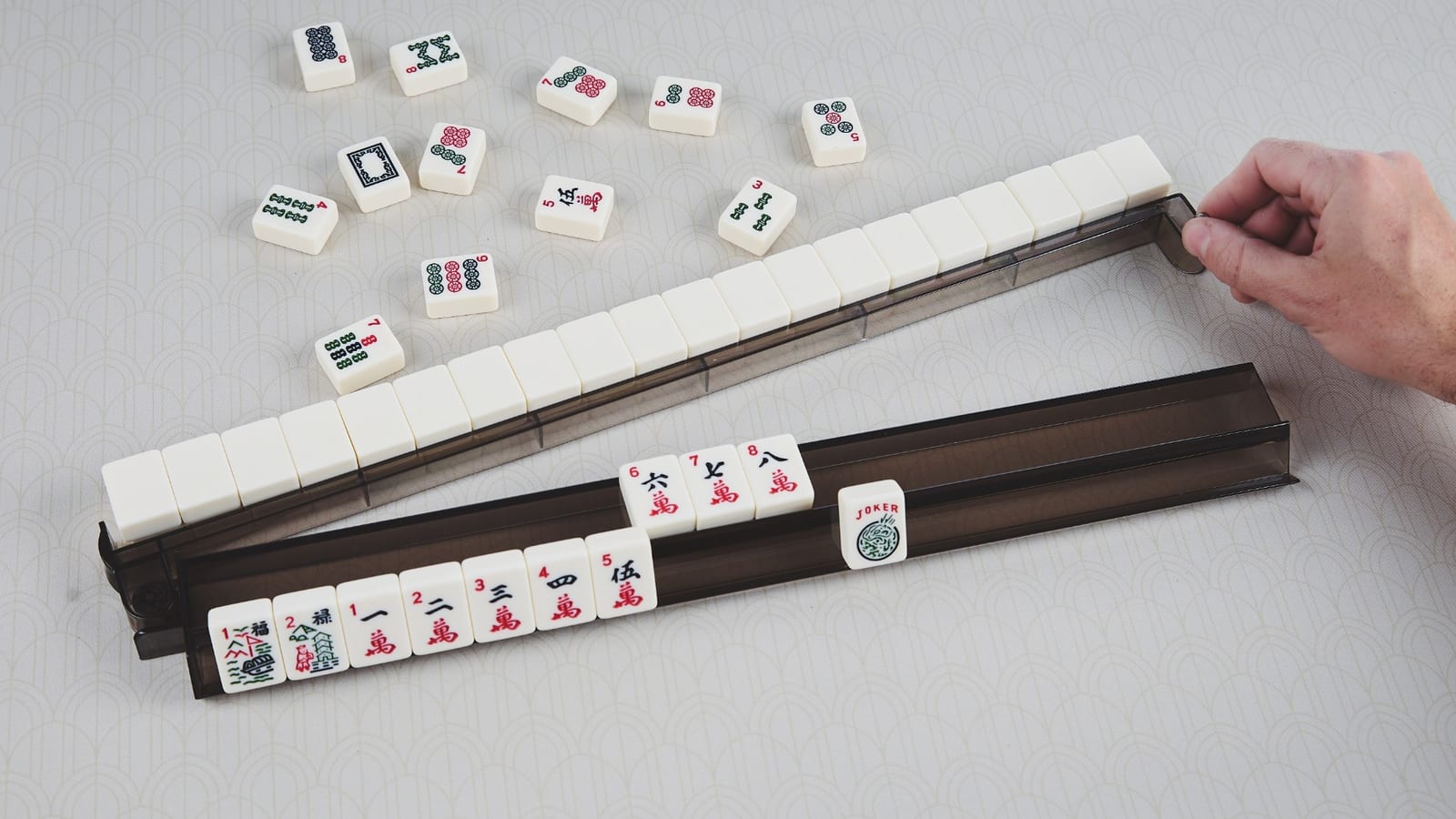
Every game of American mahjong starts with a little dance. Before anyone discards, the four players pass tiles to each other. It is called the Charleston, and it is your best chance to shape your hand before play begins.
If it feels confusing at first, you are not alone. Here it is, one pass at a time.
Before you start
Build the wall, deal the tiles and set them on your rack. East has 14 tiles and everyone else has 13. Look at your tiles and think about which hands on the card they could become.
New to the tiles? American Mahjong Tiles Explained shows each kind and how to spot it.
Every pass is 3 tiles, face down. Set them in front of the player who will get them, and pass yours before you pick up the ones that come to you. Once you pick those up, your pass is final.
You can pass any tile, Flowers included, except one: Jokers are never passed. Not in the Charleston and not in the optional pass.
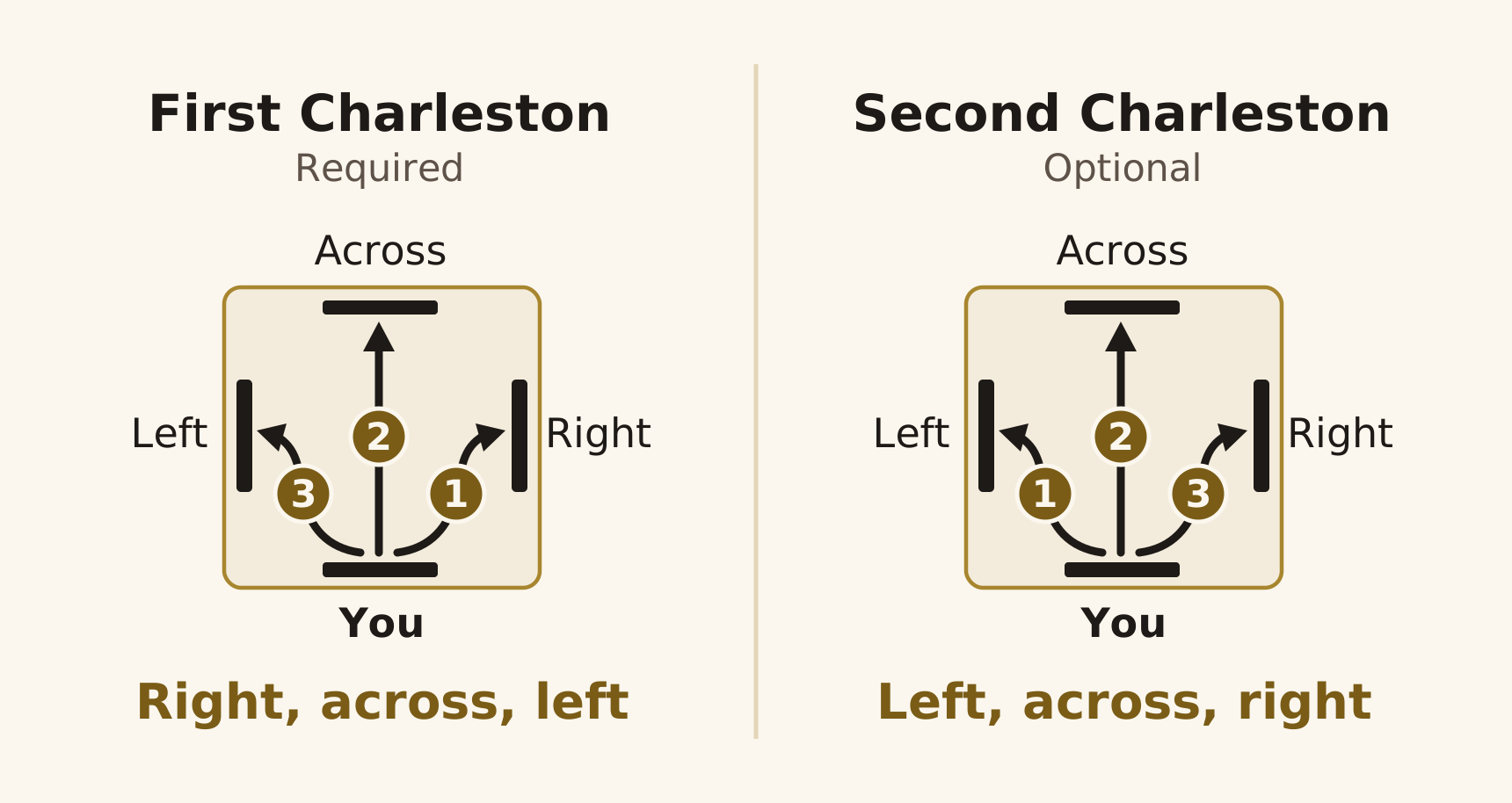
The first Charleston: right, across, left
The first Charleston is required. Everyone does it, even with a hand they love. (In a four-player game, the only time there is no Charleston is when East is dealt a winning hand.)
- Right. Pass 3 tiles to the player on your right.
- Across. Pass 3 tiles to the player across the table.
- Left. Pass 3 tiles to the player on your left.
An easy way to remember it: the first Charleston goes right, across, left, and the second one goes back the other way.
The blind pass
On the last pass of each Charleston, you may not have 3 tiles you want to give away. Then you can make a blind pass: take 1, 2 or 3 of the tiles that just came to you, without looking at them, and pass them along. If you pass fewer than 3 of them, add tiles from your hand to make 3.
The blind pass is allowed only on two passes: the pass to the left that ends the first Charleston, and the pass to the right that ends the second one.
When everyone wants a blind pass: "I.O.U."
A blind pass uses the tiles that come to you. So what happens when all four players want to pass blind? Someone has to start with tiles of their own.
A player asked the National Mah Jongg League exactly this, and the League answered in the questions and answers of its 2024 bulletin (question 1). The question: all 4 players want to "steal" (make a blind pass) on the first left, so who goes first, and with how many tiles? The League's answer:
- East starts. East passes 1 or 2 tiles and says "I.O.U." to the next player.
- Everyone else does the same. Each player passes 1 or 2 tiles along and says "I.O.U." to the next player.
- East settles up. When East picks up the last pass of that Charleston, East gives each player the tiles still owed.
The answer is not only for all four: whenever more than one player wants a blind pass, East starts. Everyone ends the pass with the right number of tiles.
The League's rulebook, Mah Jongg Made Easy, describes it a little differently: the player with the most tiles to pass starts. We follow the bulletin because it answers this exact case.
The second Charleston: left, across, right
When the first Charleston is over, the table can do a second one. It is optional, and any player can stop it, without giving a reason. If one player says no, nobody does it. Before you begin, just ask the table: "Second Charleston?"
If everyone wants it, the passes go the other way:
- Left.
- Across.
- Right.
It can still be stopped after it starts, as long as nobody has looked at the tiles passed to them.
The optional pass
Last comes one more pass, only with the player across from you. The League's rulebook calls it the optional pass, and many players call it the courtesy pass. You can make it after the first Charleston or after the second one. Each of you says how many tiles you would like to trade: 0, 1, 2 or 3. If you ask for different numbers, you both pass the smaller one. If either of you says 0, there is no pass.
Then East discards the first tile, and the game begins.
What to pass
- Decide early. Pick two or three hands your tiles could make, and keep the tiles that fit more than one of them.
- Pass the loners. A single tile that fits none of your hands is usually a good one to pass.
- Keep your pairs. Pairs are hard to come by, so pass single tiles first. Break a pair only when it fits none of your hands.
- Watch what comes back. The tiles you get tell you a little about what your neighbors are not collecting.
- Stay flexible. Your plan can change after every pass, and that is fine.
What not to pass
- Three tiles that go together. Three of the same number in different suits, or tiles that could join into a run, can hand your neighbor half a hand.
- Two of a kind at once. Two 4s, or North and South together, help whoever gets them more than you think.
- Soap too early. The white Dragon is used as zero in the hands with the year, so passing it early can point a neighbor toward those hands. Pass it later, once hands have taken shape.
- Jokers. They are never passed, as you saw above.
Common mix-ups at the table
- Going the wrong way. Say the direction out loud before each pass: "First right!" Many tables do this so nobody gets lost.
- Passing 2 or 4 tiles. Count to 3 every time. Only the optional pass and a blind pass can use fewer of your own tiles.
- Getting a Joker. If one comes to you by mistake, hand it right back and ask for another tile.
- Ending up with the wrong number of tiles. The game has not started until East discards, so a mix-up in the Charleston usually means a new deal, not a penalty. (One exception: if the player to East's left is short exactly one tile, they take the next tile from the wall before East discards.)
For the rest of the basics, from the tiles to how a turn works, read How to Play American Mahjong: A Beginner's Guide or see Learn to play.
And when a question comes up at your table that nobody can settle, our workbook explains 100 table rulings, one by one:
Have a question about these rules? Write to us. We read every message, and your question may become a future post.
Sources
We explain the rules in our own words, and everything in this post was checked against the official sources of the National Mah Jongg League:
- Mah Jongg Made Easy (2024 edition), pages 12 to 14 and page 17: the two Charlestons, the blind pass, the optional pass, and what to do with the wrong number of tiles.
- NMJL bulletin, 2024 questions and answers: question 1 (the I.O.U.) and question 13 (a mix-up in the Charleston means a new deal).
- NMJL bulletin, 2025 questions and answers: question 2 (your pass is final once you pick up the tiles passed to you).
- NMJL bulletins, 2014 and 2016 questions and answers: any tile but a Joker may be passed (2014, question 3), and a Joker passed by mistake goes back (2016, question 2).
The tips on what to pass and what not to pass are advice, not rules. They come from Tom Sloper's mah-jongg columns at sloperama.com.
Mahjong help by email every week
Our newest blog posts and one rules question players often ask, with the answer. When we have a new book or accessory, you’ll read about it there too.
Keep reading
 Learn the game
How to Learn American Mahjong Before You Buy a Set
 Learn the game
American Mahjong Tiles Explained